Thin Air devlog #1: the air is the frontier
In our RTS your army is people, and outside your base there is no air to breathe. This is how the air bubbles work and why they change everything.
Thin Air4 min read
By HiMesh Studios · about Thin Air, an interplanetary real-time strategy game by HiMesh Studios
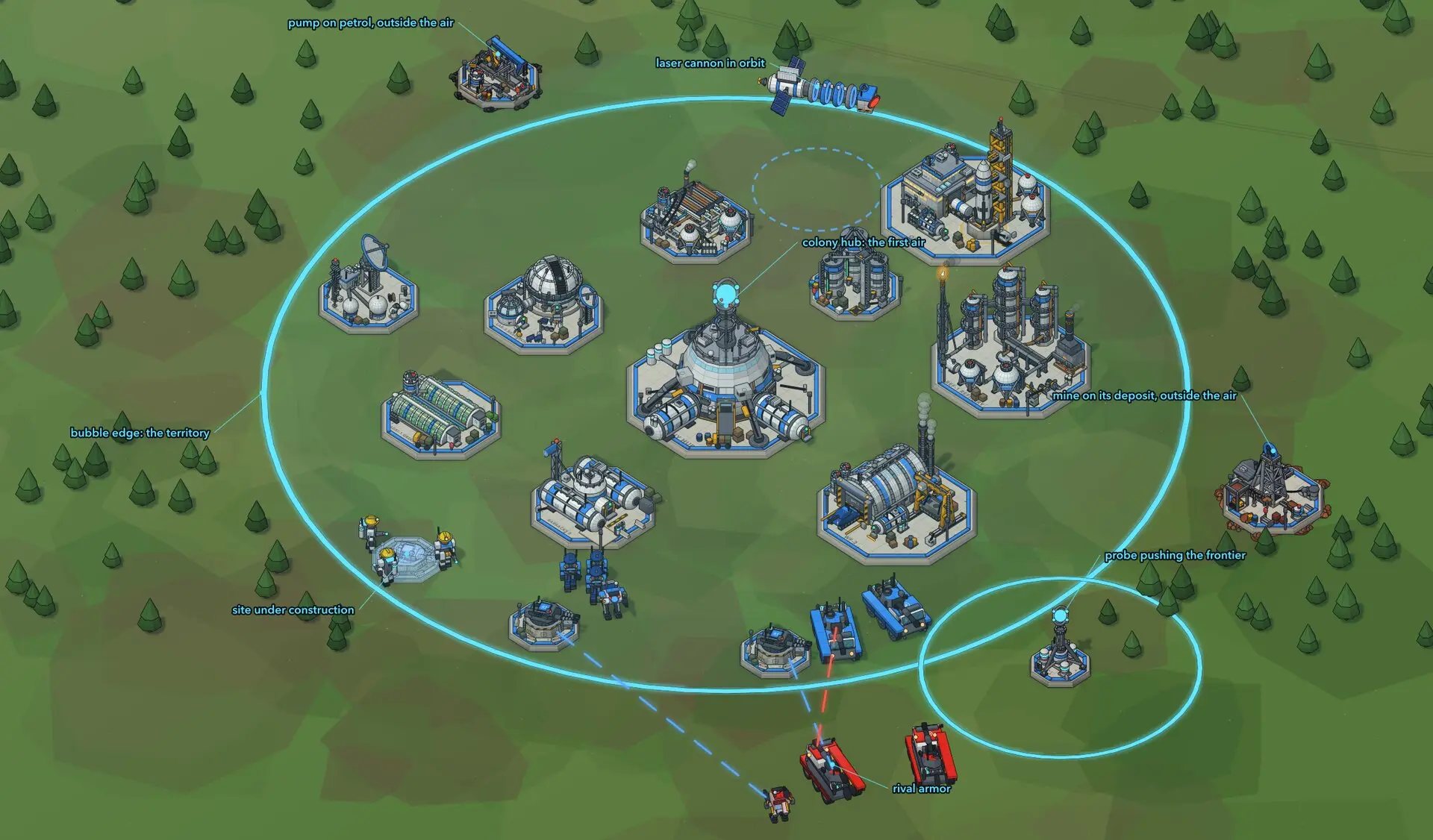
In most strategy games you can stand anywhere in the map. In Thin Air almost everywhere you die.
Thin Air is a real time strategy game in a full star system. You give orders to your people directly: select a group, send them somewhere, build something. You can do this on every planet, moon and asteroid. And the camera goes from the whole system to one soldier on the ground in one zoom, with no loading screen.
The thing is, your army is people. And in the other worlds there is no air that people can breathe.
The bubble is your territory
Every colony lives inside bubbles of air. A probe makes a sphere of air around it, and inside the sphere your people can work normal, without anything. Outside, they need a respirator or a suit. If not, they die.
So where your air ends, your territory ends too.
We simulate the air inside each bubble. Every bubble has some quantity of oxygen, nitrogen and CO₂, and every person inside is breathing it. One person uses about 0.84 kg of oxygen per day and gives back 1 kg of CO₂, these are the real numbers for a human. The probe can compensate this, but only for a number of people. If you put too many people inside, the CO₂ goes up and up, and in the end they need respirators even inside the base. (Like in real life, the CO₂ is a problem much before the oxygen finish.)
How bad is outside?
For every place, the surface of a planet, a bubble or the cabin of a tank, the game looks at the same things: how much of each gas there is, and the temperature. With this it decides what protection a person needs to survive there:
| Gear | When you need it |
|---|---|
| Nothing | The air is similar to Earth |
| Respirator | Too little oxygen, too much oxygen, or too much CO₂ |
| Pressure suit | The pressure is too low, or it is colder than −40 °C or hotter than 50 °C |
| Hardsuit | The pressure is very high, or the cold or heat is extreme |
| Uninhabitable | Only robots and special buildings survive |
We took the limits from the real human body and we rounded them, so they are easy to read. If you have one level less than you need (for example, no respirator on Terra Nova) you die slow, in about one day of the game. If you have two levels less (vacuum with no suit), you die in seconds.
You can attack the air
This is the part we like the most. If a probe is turned off, has no power or is destroyed, the bubble collapses. Everyone inside is suddenly in the air of the outside.
On Terra Nova, the green world where you start, this is a problem but not the end, people have some time to get a respirator. On Selene, the moon next to it that has no air at all, everybody dies.
That is why the probes are always the first target when you attack, and the first thing you want to protect with turrets. A probe has only 250 of health. Also when a soldier with a suit gets hit, the suit breaks, and the soldier has no protection until going back to a bubble to fix it. With a broken respirator on Terra Nova you choke slowly. With a broken pressure suit on Selene you have some seconds.
To invade another world, you always start the same: you send a probe lander. It lands, opens a bubble, and now you have to bring your colonists and start to work before the air of the lander finish.
The system is moving
The planets and the moons follow their orbits while you play. So the distances, the time to travel and the launch windows are changing all the time. The world you want to attack can be near now and far in ten minutes. The transports, the mining satellites that send ore between worlds and the laser cannons that shoot from orbit, all of them need to think about this.
What you can play today
Thin Air is very early. Everything in this list is a first version: it works, but it is rough, and a lot of the numbers we just invented (out of thin air, sorry). This is what we have:
- Bases built by workers inside the bubbles, and an economy with petrol, iron, copper and gold
- Soldiers, bots, tanks and turrets fighting, with broken suits and bubbles that collapse
- Terrain generated on every world: mountains, craters, canyons and seas of water, lava or methane
- Transports and probe landers that travel between worlds in the launch windows
- Things in orbit: laser cannons, missile launchers and drop factories
- Fog of war, sensors and recon satellites that are invisible
- Oxygen, water and food that you need to produce in every world
- AI opponents with six levels, from Easy to Impossible
- Two maps: Helios, for up to four colonies, and Gargantua, for up to sixteen
- Multiplayer for two to four people in a local network
What we don’t know yet
Many things, to be honest. How long a match should be, 30 minutes or 60? Every unit is a person that needs air, so we think you will have hundreds of units and not thousands. But is this enough for a game with full planets? And what happens if somebody changes the atmosphere of a planet to make it breathable… for everybody, also the enemy that lives there?
If you have an opinion about any of this, please tell us, really. We read everything.
In the next devlog we will show the zoom, the camera that goes from the full star system to the ground with no loading. If you want to read it when it is ready, the RSS feed is the best way.